
A current transformer is an instrument transformer that transforms high AC voltage into a lower, typically 1 or 5A, value. This transformer steps down the current so that a normal range ammeter can measure it. That’s why the current transformer is also called a measuring transformer.
The working principle of a current transformer is slightly different from normal voltage transformer or a power transformer. A normal voltage transformer has two separate windings. Whereas, a current transformer’s primary winding has a few turns or only one.
A CT may have multiple ratios.
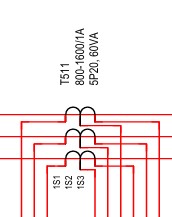
This is a multi-ratio CT. Its ratio is 800-1600/1. When the secondary cable is connected to 1s1-1s2, its ratio will be 800/1. But when the secondary cable is connected to 1s1-1s3, its ratio will be 1600/1.
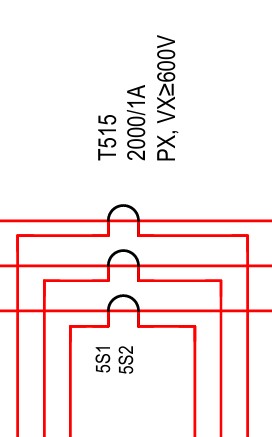
This is 2000/1 single ratio CT core.
Structure of Current Transformer
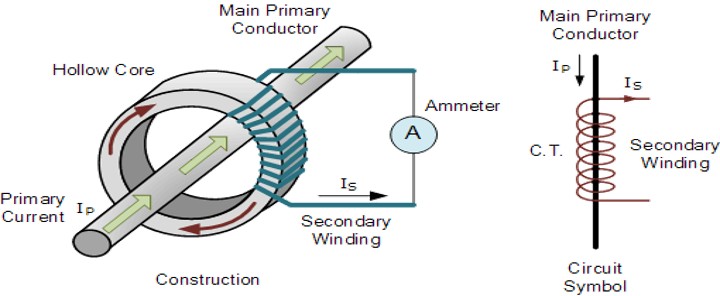
The primary winding may be just a conductor or a bus bar placed in a hollow core (as shown in the figure). The secondary winding has a large number of turns accurately wound for a specific turns ratio.
Current Transformer Ratio or CT Ratio
CT Ratio means the ratio between the primary current and the secondary current of a current transformer. This ratio may be 400/5, 400/1, 800/1, 800/5 or anything.
CT ratio 400/5 means that if 400A current flows through the CT’s primary, then 5A current flows through the CT’s secondary. And if 80A current flows through the same CT, the secondary current will be 1A. CT Ratio also called turns ratio or T.R.

Classification of CT Core
According to usages and technical specifications, there are two types of CT cores.
- Metering Core
- Protection Core
The metering core is used only for measuring purposes. It is used for energy meters, ammeters, and watt meters.
On the other hand, the protection core is used for protection. It is used for overcurrent protection, earth fault protection, differential protection, distance protection, and so on.
Later in this post, we will discuss the technical specifications of the metering core and the protection core. At first, know some technical terms.
CT Ratio Error, Rated Burden, ALF, Accuracy Class, Knee Point Voltage
Let’s discuss CT’s technical terms. You may find some of these terms for potential transformer also.
Rated Primary and Secondary Current
The value of primary & secondary current on which the performance of the current transformer is based.
For example, a CT with a ratio of 300:5 is rated for 300 primary amps & 5 secondary amps.
Rated Burden
The burden in a CT is the (largely resistive) impedance presented to its secondary winding.
Typical burden ratings for IEC CTs are 1.5 VA, 3 VA, 5 VA, 10 VA, 15 VA, 20 VA, 30 VA, 45 VA and 60 VA.
Ratio Error
Primary current is not exactly equal to the secondary current multiplied by turns ratio. This difference is due to the primary current is contributed by the core excitation current.
Phase Angle Error
The deviation in the phase angle of the primary and secondary current is called the phase angle error. The phase angle between the primary and secondary of the current transformer must be 180 degrees. The primary and secondary current must be out of phase.
Accuracy Class
The accuracy class of a current transformer refers to the allowable error limit under specified conditions. It is expressed as a percentage of primary rated current.
The lower the accuracy class, the higher the accuracy of the current transformer.
Instrument Security Factor (ISF):
ISF or instrument security factor of current transformer is defined as the ratio of instrument limit primary current to the rated primary current.
The instrument limit primary current of metering CT is the value primary current beyond which CT core becomes saturated. ISF= CT Saturation current/CT rated primary current.
Example : 400/1A CT, ISF <5. For 2000A primary, secondary 5A, CT saturated.
The Accuracy Limit Factor (ALF)
The accuracy limit factor (ALF) defines a CT’s ability to maintain accuracy under high fault current conditions.
The ALF signifies the multiple of rated primary current at which the CT remains unsaturated.
Knee Point Voltage
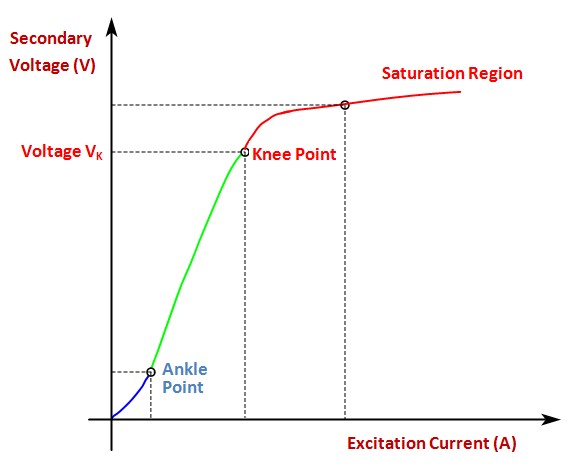
The knee point is defined as the voltage at which a 10% increase in applied voltage increases the magnetizing current by 50%. For voltages greater than the knee point, the magnetizing current increases considerably even for small increments in voltage across the secondary terminals.
The knee point voltage is a critical parameter because it defines the level of fault current that a CT can accurately measure before saturation occurs. Beyond the knee point voltage, the CT’s accuracy diminishes, and it may not be able to provide accurate current measurements during fault conditions.
Characteristics of Measuring Core Current Transformer
The CT metering core must have higher accuracy, otherwise energy meter reading will not be accurate. Also metering core should have rated burden and instrument safety factor (ISF).
Metering core ratings may be Ratio 2000/1, Class 0.2, 20VA, ISF – 5.
The errors are specified between 5-120% of rated current and 25-100% of rated burden connected
Characteristics of Protection Core Current Transformer
Protection CT are specified in terms of Ratio, Accuracy class, Burden (VA rating), ALF (Accuracy Limit Factor) Example: 200/1, 5P20, 10VA.
Here, 5P20 means 5 is accuracy class and 20 is accuracy limit factor. So, 5P20 means, accuracy limits will be within 5% even 20 times of rated current.
Also, protection core should have higher knee point voltage.
That’s all for today. We will update and enrich it day by day. So visit power synchro regularly Thanks for your reading.